read this article this morning from an older issue of the New York Times entitled, A Plan to Spur Growth Away From Haiti’s Capital . This article talks about a plan that was unveiled a few months ago that will rebuild Haiti by decentralizing its urban core through land use practices designed to create smaller urban and rural cores.
Based upon my American planning knowledge, the first thing I thought was how backwards does this sound? Decentralizing the city? American cities are on a rapid decline; populations in the city are decreasing while suburban populations are increasing. In Haiti, the expected growth for Port-au-Prince is targeted to hit 6,000,000 in the next 15 years. The population is expected to double from its 3,000,000 inhabitants now.
Upon further investigation, this plan is in fact very fitting giving the condition of the country and the surrounding environmental concerns:
Prepared by a group of urban planners from the Haitian government agency responsible for the country’s development, the plan is built around a bold central idea: to redistribute large parts of the population of Port-au-Prince to smaller Haitian cities, many of them at a safe distance from areas most vulnerable to natural disaster. In the process the plan would completely transform Haiti from a country dominated by a single metropolis to what the planners call a network of smaller urban “growth poles.”
As part of this plan come an array of new zoning and land-use regulations that will transform the capitol and the country, plans for a light rail system, a waterfront park in Port-au-Prince, and smaller public spaces throughout the region.
As with most plans, these ideas are great but the crucial component will be finding funding and political support in a country that is still on its knees six months later.
Showing posts with label revitalization. Show all posts
Showing posts with label revitalization. Show all posts
Tuesday, July 20, 2010


Wednesday, July 14, 2010
Urban Decay.....How do we handle it?
Let's chat about Urban Decay for a minute... and no I'm not reffering to the pretty eyeshadows you can buy at Sephora
+What is Urban Decay: the process whereby a previously functioning city, or part of a city, falls into disrepair and decrepitude. It may feature deindustrialization, depopulation or changing population, economic restructuring, abandoned buildings, high local unemployment, fragmented families, political disenfranchisement, crime, and a desolate, inhospitable city landscape.
Does this sound like a familar place to you?


+What is Urban Decay: the process whereby a previously functioning city, or part of a city, falls into disrepair and decrepitude. It may feature deindustrialization, depopulation or changing population, economic restructuring, abandoned buildings, high local unemployment, fragmented families, political disenfranchisement, crime, and a desolate, inhospitable city landscape.
Does this sound like a familar place to you?
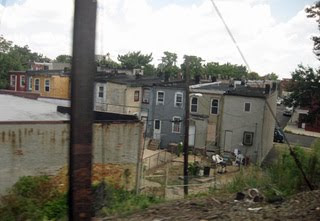
Baltimore, once a thriving port city off of the Chesapeake Bay faced a decline after its period of deindustrialization. Once the second largest city in the nation with close to one million persons, this city now has around 650,00 residents. The mass exodus has left us with some visual examples of urban decay:

Abandoned rowhomes, abandoned and boarded up city blocks, garbage filled lots...These are the marks of Baltimore's City Urban Decay


Just about eery major city has some form of Urban Decay: Cleveland, Detroit, Chicago, New York, Miami, Tampa, Washington DC, Philadelphia, Los Angeles, Tampa, Dallas, and the list goes on and on.
The sad thing about Urban Decay is that many of these areas were once thriving communities with middle/working class citizens. The decisions of city and local officials in the planning department, highway construction, economic recessions, massive job layoffs, plant and industrial facility closures, sprawl and suburbanization, and crime are all contributing to factors to Urban Decay.
Until these areas are revitalized and redeveloped, how do we handle the linger populations in these areas? How do we ensure that despite their surroundings that they still have the same opportunities and resources as those in suburbia? How do we ensure that the children growing up still recieve a quality education? How do we ensure that the psychological effects of growing up in these conditions are addressed?
Is demolishing these areas to the ground and relocating the residence a viable solution? Is a redevelopment strategy that will change these areas to bustling commercial/retail/residential/mixed-use corridors the best option?What happends when these who live here are displaced?
Just because you change the facade and appearance of urban decay with trendy architecture and innovative planning strategies doesn't mean that we have addressed the sociological and mental issues assosciated with decay....
Your thoughts???
Subscribe to:
Posts (Atom)